
Introduction to AI Agents in Ecommerce
Online retail has quietly crossed a threshold. What used to be static storefronts pages that displayed the same banners and product grids to every visitor are being replaced by adaptive systems that observe, reason, and act. This is the domain of the AI agent: a piece of software that doesn't just execute a fixed script but perceives context, makes decisions, and pursues an outcome with a degree of autonomy. Traditional automation tools, by contrast, are rule-bound. They follow "if this, then that" logic, and they break the moment a scenario falls outside their predefined conditions. An AI agent behaves differently. It learns from data, adjusts its behavior as circumstances shift, and can chain together multiple actions searching, recommending, negotiating, escalating without a human dictating each step.
This distinction is why AI Agents for Ecommerce Are Changing the Shopping Experience so fundamentally. A rules-based chatbot might answer "where is my order?" with a canned response. An agent can query the logistics API, cross-reference the customer's purchase history, detect frustration in the phrasing of the question, and offer a proactive resolution all within a single exchange.
Ecommerce businesses are adopting these tools at a rapid clip, and the reasons are more pragmatic than trendy. Margins in online retail are thin, customer acquisition costs keep climbing, and the businesses that survive are the ones that squeeze more value out of every visitor. AI agents offer a lever for doing exactly that: they lower the cost of personalization, they compress support response times, and they surface revenue opportunities that a human team simply doesn't have the bandwidth to catch manually.
The broader trajectory is a shift away from static websites and toward intelligent, adaptive shopping platforms. A modern storefront increasingly resembles a living system one that reconfigures its own layout, tailors its own messaging, and anticipates needs before a shopper has articulated them. This shift isn't cosmetic. It's structural, reaching into inventory systems, customer service pipelines, and marketing engines simultaneously.
Underpinning all of this is a change in what customers expect. Shoppers who've grown accustomed to algorithmic curation on streaming platforms and social feeds now bring those same expectations to retail. A generic, one-size-fits-all website feels dated by comparison almost archaic. Meeting that expectation gap is no longer optional; it's table stakes for staying competitive.
Personalized Shopping Experiences Powered by AI Agents
Personalization used to mean inserting a customer's first name into an email subject line. AI agents have pushed the concept into far more sophisticated territory.
Real time product recommendations are the most visible example. Rather than relying on static "customers also bought" logic, modern recommendation engines track browsing behavior as it happens dwell time on a product page, scroll depth, items added and removed from a cart and adjust suggestions on the fly. The result is a feed of recommendations that feels less like a guess and more like it's reading the shopper's intent.
Dynamic content and layout personalization go a step further. Two visitors landing on the same homepage might see entirely different hero banners, category orderings, or promotional messaging, calibrated to their inferred preferences and purchase stage. A first time visitor exploring casually gets a different experience than a returning customer close to a repeat purchase.
This same intelligence extends into outbound channels. AI driven personalized email and push notification campaigns segment audiences at a granularity that manual marketing teams can't replicate, timing messages around individual behavioral patterns rather than a blanket send schedule. A cart abandonment reminder, for instance, can be tuned to the specific item left behind, the customer's historical price sensitivity, and even the optimal hour they tend to open emails.
The payoff shows up in retention metrics. Personalization, done well, correlates strongly with repeat purchase rates and customer lifetime value shoppers return to platforms that seem to understand them, and that familiarity compounds over time into loyalty that's hard for competitors to dislodge with price alone.
AI Chatbots and Virtual Shopping Assistants
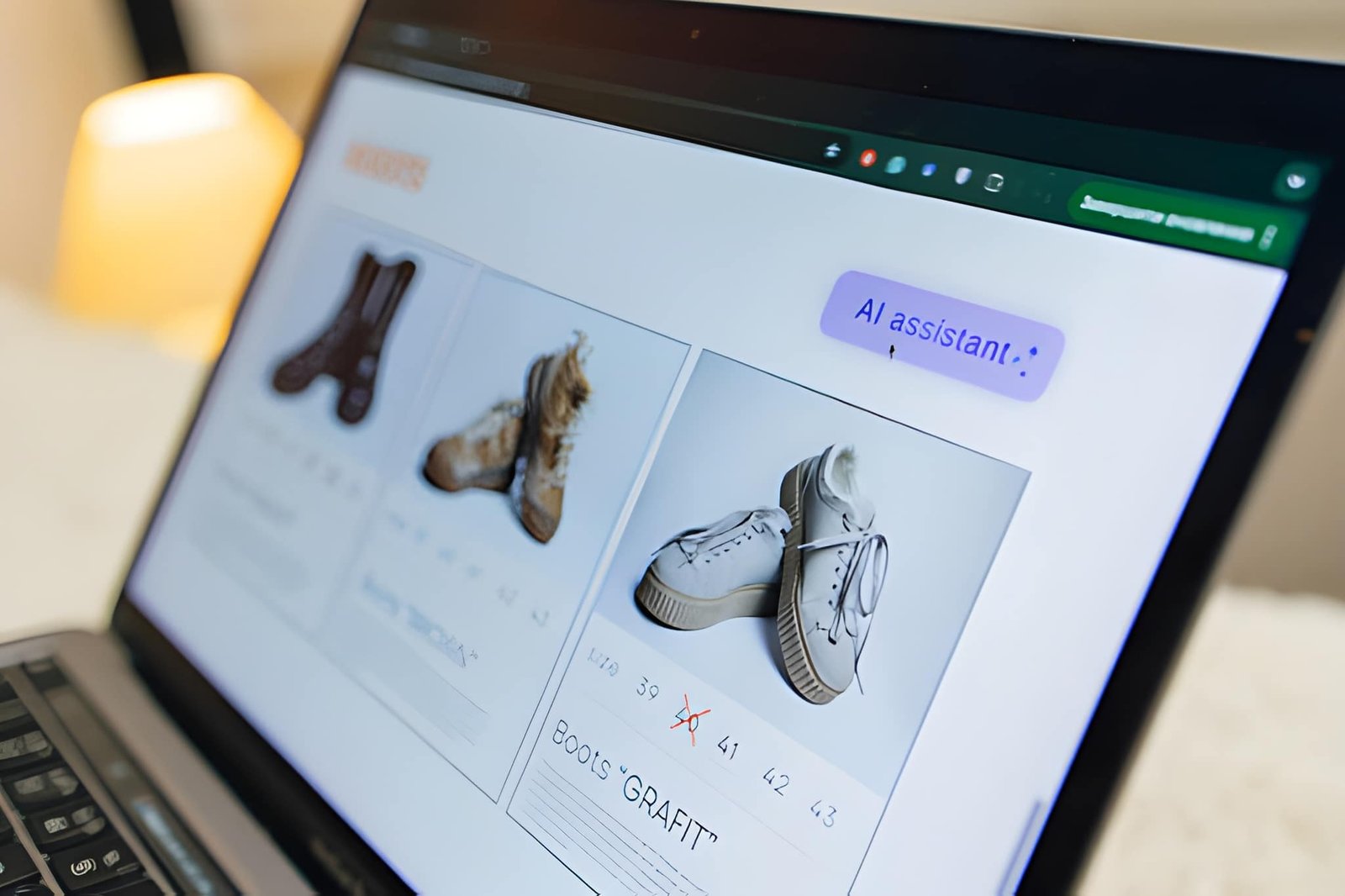
Conversational AI has moved well past the clunky, keyword-triggered chat widgets of a decade ago. Today's virtual shopping assistants can guide a customer through comparative decision making weighing features, surfacing reviews, and narrowing a broad category down to a shortlist in a way that mimics an attentive in-store associate.
The always on nature of these agents is a structural advantage. Round-the-clock customer support without human intervention means a shopper browsing at 2 a.m. gets the same responsiveness as one browsing at midday, without the overhead of staffing a night shift.
These assistants also absorb the repetitive load that used to consume human support teams: answering FAQs, tracking orders, and resolving simple product queries instantly. That frees human agents to focus on complex, high-stakes interactions where empathy and judgment genuinely matter.
For businesses that want this capability without building it from scratch, the practical path is to build an onsite shopping assistant using an established development partner rather than assembling one from disconnected tools. This is where solutions like way2smile.ae come in offering ecommerce brands custom AI assistant deployment that's tailored to their catalog, tone, and customer base rather than a generic, off-the-shelf bot bolted onto a website.
Smarter Product Search and Discovery
Search has historically been one of the weakest links on ecommerce sites a plain text box that returns literal keyword matches and little else. AI is closing that gap through visual and voice search capabilities that let customers find products the way they naturally think about them: by describing what something looks like, or simply speaking a request aloud.
Natural language processing underpins much of this improvement, parsing the intent behind a query rather than just its literal words. A search for "warm jacket for hiking in cold weather" should surface relevant outerwear even if none of the product titles contain that exact phrasing and NLP driven search engines are increasingly capable of that inferential leap.
The downstream effect is a meaningful reduction in bounce rates. When search returns irrelevant or sparse results, shoppers leave. Intelligent search suggestions keep them engaged by guiding them toward relevant alternatives even when their initial query is vague or misspelled.
This intelligence particularly benefits niche and long-tail products items that don't have the search volume or brand recognition of bestsellers but still represent meaningful revenue. Improving discoverability for these products means fewer good items get buried on page four of search results, effectively invisible to the customers who'd actually want them.
AI-Driven Inventory and Demand Forecasting
Behind the storefront, AI agents are reshaping how ecommerce businesses manage stock. Predictive analytics can model demand curves with a precision that spreadsheet based forecasting never achieved, factoring in seasonality, regional trends, marketing calendars, and even external variables like weather patterns.
This precision translates directly into fewer costly imbalances. Reducing overstocking and stockouts through AI forecasting protects margin on both ends overstocking ties up capital in unsold inventory, while stockouts mean lost sales and, often, lost customers who go elsewhere and don't come back.
Increasingly, this forecasting connects directly into operational workflows. Automating supplier and reorder processes means the system doesn't just predict that stock is running low it can initiate the reorder itself, within parameters a business sets, closing the loop between prediction and action.
The benefit compounds during high stakes periods. Accurate demand prediction is especially valuable ahead of seasonal sales events, where the cost of guessing wrong whether through wasted inventory or missed revenue during peak demand is magnified by the sheer volume moving through the system in a short window.
Enhancing Customer Support and Retention through AI
Support operations are another area where AI agents quietly compound value over time. AI-powered ticketing and support automation triages incoming issues, routes them to the right resource, and resolves the simplest cases without any human touch at all.
Sentiment analysis adds a layer of nuance to this process. By detecting frustration, urgency, or dissatisfaction in a customer's phrasing, AI systems can flag conversations that need escalation before they spiral into a negative review or a lost customer turning a reactive support model into a proactive one.
The same techniques extend to public-facing content. Automated review and feedback management helps businesses process large volumes of customer commentary, surfacing recurring complaints or praise that might otherwise get lost in the noise of hundreds or thousands of individual reviews.
Taken together, these capabilities let businesses use AI insights to reduce churn and strengthen loyalty programs identifying at risk customers based on behavioral signals and intervening with targeted offers or outreach before that customer quietly drifts to a competitor.
Implementation Timeline: How Businesses Can Adopt AI Agents
Adopting AI agents isn't a single switch to flip; it's a phased process that rewards careful sequencing.
It typically begins with an initial assessment and planning phase, where a business audits its existing systems, identifies the highest friction points in the customer journey, and defines what success actually looks like before any code is written.
From there, choosing the right AI tools and development partners becomes the critical decision. Working with an experienced partner like way2smile solutions can shorten this phase considerably, since established teams bring pre-built frameworks and integration experience rather than requiring a business to solve every technical problem from first principles.
Rollout generally follows a familiar arc: pilot testing on a limited scope a single product category or a specific customer segment followed by scaling to the broader platform once the pilot validates its assumptions, and finally an ongoing optimization phase where the system is refined based on real performance data rather than initial projections.
Timeframes vary considerably by business size. A small ecommerce operation might deploy a focused chatbot or recommendation engine within a few weeks. Mid-sized businesses integrating multiple AI agents across search, personalization, and support might reasonably plan for a few months. Large enterprises coordinating AI across complex, multi system architectures should expect a longer runway often spanning two quarters or more to account for the additional testing, compliance, and integration work at that scale.
Future of AI Agents in Ecommerce Websites
The trajectory ahead points toward even greater autonomy. Emerging trends include autonomous shopping agents capable of completing entire purchase journeys comparing prices across platforms, applying discount codes, and finalizing checkout with minimal human oversight, alongside hyper-personalization that adapts not just recommendations but pricing, bundling, and messaging to the individual shopper in real time.
Generative AI is also reshaping content operations. Product descriptions, marketing copy, and even personalized shopping guides can now be generated dynamically, reducing the manual burden of content creation while keeping messaging fresh and relevant across a large catalog.
Industry forecasts consistently point toward accelerating growth in AI-driven ecommerce over the coming years, as the technology matures and the cost of implementation continues to fall putting capabilities once reserved for the largest retailers within reach of much smaller businesses.
The throughline across all of this is straightforward: businesses that use AI agents to boost sales today are building a compounding advantage one that gets harder for slower-moving competitors to close with each passing quarter. Staying competitive in ecommerce increasingly means treating intelligent, agent driven infrastructure not as an experiment but as the foundation the rest of the business is built on.